Our programs · Music

Music

After-school and in-school music programs for California schools.

Ensemble pathways and instrument classes for every age and every starting point. Students grow session by session and perform at every step, from their first sing-along to the big stage. We bring the teaching artist and the instruments.

Grades TK–12

Class size 20:1 (10:1 for TK/K) after school · Full classes in school

Class length 45–60 min (30–60 for TK/K)

Ensemble pathways

Find your sound, together.

Every ensemble follows the same five-stage pathway and ends each session with a performance.

A boy playing a hand drum with other young drummers.
Starts in TK

World Music

Around the world one region at a time: Africa, Latin America, the Caribbean, Asia, and the Middle East.

A drummer playing a drum kit in a recording studio.
Starts in 1st grade

Black American Music

A journey through spirituals, the blues, gospel and soul, funk and hip-hop, and jazz.

Starts in 3rd grade

Rock Band

Students start on ukulele and percussion, then move to guitar, bass, keys, and drums.

Mariachi musicians in embroidered charro suits and sombreros.
Starts in 1st grade

Mariachi

Traditional Mexican mariachi, with singing in Spanish and the culture behind every song.

Children singing together on stage.
Starts in TK

Choir

Healthy singing, harmony, teamwork and songs from around the world.

A student in headphones making music on a keyboard and computer.
Starts in 3rd grade

Electronic Music

Beats, loops, sampling, and live electronic performance on hands-on gear, with no computers needed. Music, technology, and teamwork together.

Starts in TK

Drumline

Bucket drums to a full marching drumline, with all the energy of a halftime show.

Custom programs

Don’t see the class you’re looking for?

Our teaching artists play and teach many other styles. Tell us what your students are excited about, and we’ll build a program around it.

String orchestra
Steel pan
Musical theatre
Songwriting

Many ways to partner

Music after-school or during the school day.

The same joyful, standards-aligned program either way, scheduled around your bell schedule and customized for your students.

After school
ELOP & PTO/PTA

After-school music programs

Hands-on enrichment for after-school, before-school and intersession programs that meet California’s Quality Standards for Expanded Learning.

20:1 student-to-staff ratio (10:1 for TK/K)

Programs customized for your school so it complements your existing enrichment schedule.

A showcase to finish every session

During the school day
Prop 28 · VAPA

In-school music residencies

Standards-based music instruction during the school day, planned with your classroom teachers.

Full classes of up to 35 students, with the classroom teacher in the room

Adds to your music offerings, never replaces them

Research-based curriculum rooted in SEL and STEM concepts designed to improve student learning.

Bigger after-school group? We can discuss adding additional support to keep us compliant.

Standards & funding

Built on the California Arts Standards for Music

Every class, at every stage, is aligned to the California Arts Standards for music, the state’s current VAPA standards, and each class lists its focus standards. For ELOP and other after-school programs, we provide attendance records and end-of-session summaries for your reporting. For Prop 28 (Arts and Music in Schools), our in-school residencies add to a school’s music offerings instead of replacing them, with a research-based curriculum rooted in SEL and STEM concepts designed to improve student learning.

Please confirm funding eligibility with your district.

Creating

Improvising, arranging, and writing original music.

Performing

Rehearsing, reading music, and taking the stage.

Responding

Listening closely and understanding how styles are built.

Connecting

Linking music to culture, history, and students’ own lives.

How the pathway works

One pathway, five stages.

Students start at the stage that fits them now, whatever their grade or experience, and a class can mix stages, with a part for every player. Classes run in sessions, usually 8 to 12 weeks, planned around your school calendar. Students move to the next stage when they pass a short skills checklist at their showcase.

Often TK–2

Explore

Sing, clap, explore

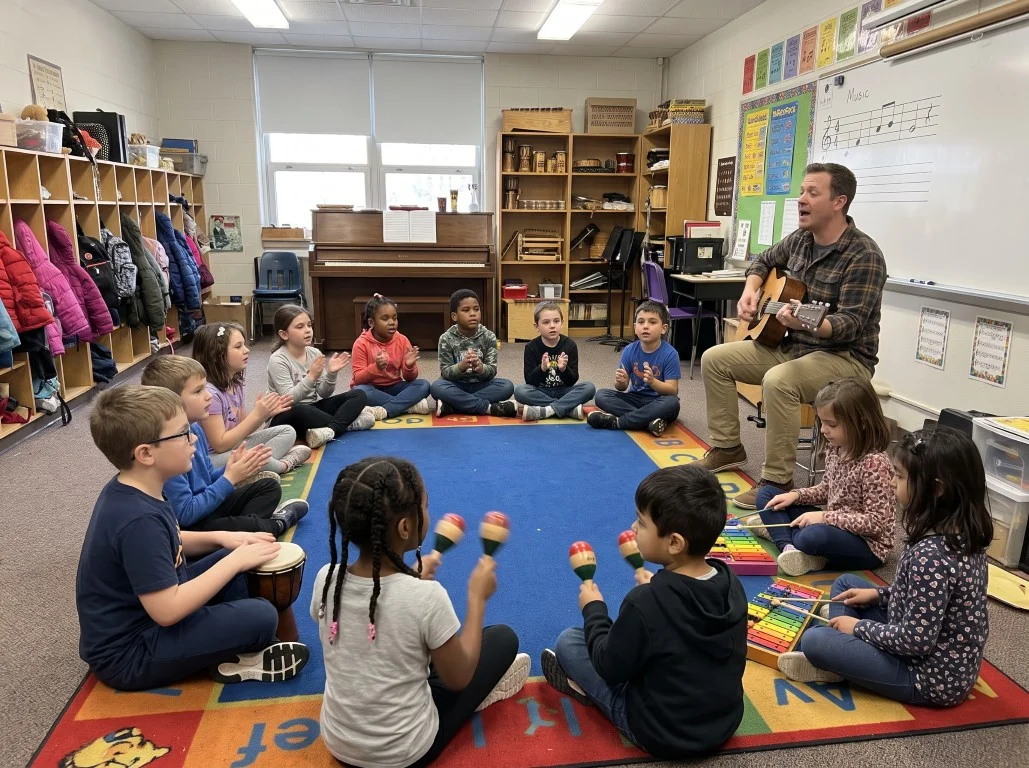
Songs, rhythm games, and hands-on time with real instruments. New songs each session, so students can come back again and again.

Often Grades 1–4

Play

Play as a group

Kid-sized instruments and simple parts for a first real ensemble performance.

Often Grades 3–5

Build

The bridge stage

Bigger instruments, harmony, and new parts. The skills carry straight over to the next instrument.

Often Grades 4–6

Choose

Choose your instrument

Students pick the instrument or voice part they love. First original songs and first community shows.

Often Grades 6–8

Perform

Take the stage

A full performing ensemble with solos and section leaders, ready for rallies, assemblies, and big shows.

World Music, Choir, and Drumline start in TK, Mariachi and Black American Music in 1st grade, and Rock Band and Electronic Music in 3rd grade. Grades are only a guide: a 5th grader new to music starts at the beginning, and an experienced 3rd grader can move ahead.

Why a pathway matters

Kids keep growing, and keep coming back.

A show at every stage

Each stage ends in a showcase, so everyone sees real progress, not just a report card.

Built on age and skill

Songs, pacing, and instruments fit each age group, and placement looks at skill too.

The right instrument at the right time

Kid-sized instruments first, then a bridge stage, then students pick the instrument they love.

A reason to come back

A short skills checklist means there is always a next step to reach for.

Easy for any campus

Small site? We combine stages with parts for each student. Explore and Perform can repeat as many sessions as students like.

A showcase students are proud of

Every session ends with a class share, assembly, or concert, which builds attendance and school pride.

Instrument classes

A deeper dive into one instrument.

Three stages each, a recital at every stage, and a direct path into the ensembles.

1. Foundations
2. Building Skills
3. Performance
A young girl playing the ukulele.
Starts in K

Ukulele

The easiest place to start: first chords, strumming, and singing while playing.

Leads to: Rock Band, Mariachi

Starts in K

Piano & Keyboard

Real music reading from day one, building to both hands in classical, pop, and jazz.

Leads to: Rock Band, Black American Music

A child playing guitar outdoors with classmates.
Starts in 3rd grade

Guitar

Open chords and strumming, then riffs, solos, and improvising.

Leads to: Rock Band, Mariachi, Black American Music

A boy playing the violin outdoors.
Starts in 3rd grade

Violin

Technique and reading, with classical, folk, and mariachi styles along the way.

Leads to: Mariachi

A young drummer sitting at a drum kit.
Starts in 2nd grade

Drums & Percussion

Practice pads to full drum kit grooves, fills, and hand percussion.

Leads to: Rock Band, Drumline, World Music

Social-emotional learning

Every rehearsal is SEL in action.

Playing in an ensemble is SEL in action: listening, taking turns, and counting on each other. Each class opens with community agreements and closes with reflection. Our programs map to all five CASEL competencies and the California Department of Education’s SEL Guiding Principles.

Every student is a musician. No experience needed. We adapt instruments and parts for students with IEPs and 504 plans, support English learners with rhythm, gesture, and visuals, and keep every role open to every student.

Our teaching artists

Working musicians who love to teach.

Every class is led by a trained Culture Club teaching artist who knows the music, the culture behind it, and how to run a joyful, well-managed room.

Mentors, not just teachers

Our teaching artists are invested in every student’s growth. They show students how to keep learning on their own, set goals, and build life skills that last long after the last class.

Live Scan (DOJ and FBI) background clearance and TB clearance

Annual mandated reporter training

Trained in SEL, inclusive teaching, and culturally responsive practice

Culture bearers and guest artists join us whenever possible

Instruments included

We bring the instruments, and everything else.

Every student gets an instrument in their hands, sized for their age. No equipment to buy, no music to find, no lesson plans to write.

A teaching artist

Trained, cleared, and ready on day one.

A full class set

Enough instruments for every student, with kid-sized gear for the younger stages.

Sound & amps

Speakers, amps, and mics, plus a portable PA for showcases.

Music & lesson plans

Standards-aligned plans and arrangements for every stage.

A final showcase

A class share, assembly, or concert. You choose.

Reports & take-homes

An end-of-session summary for your records and practice ideas for families.

A young girl playing a xylophone with her teacher.

Nothing for you to provide

No instruments to buy and no setup for your staff. We coordinate the schedule and a room with your site lead and take it from there. Electronic Music needs no school computers.

Want to own your instruments? We can recommend a class set for your campus and help you plan it with Prop 28 or ELOP funds.

Keep exploring

More ways to create, connect, and grow.

Dance Around the World, hip hop, ballet, folklórico, and West African dance.

Budō, the martial way: respect, self-control, and confidence.

For schools

How to partner

ELOP after-school programs, Prop 28 arts instruction, and four simple steps from first call to final showcase.

Bring music to your campus.

Tell us about your students and their needs. We’ll set up a quick call and find the right fit for your students whether it is after school or during the school day.

Prefer to talk? Reach out to us and we’ll find a time that works.

A quiet school music room with a piano, guitars, and a teal door.