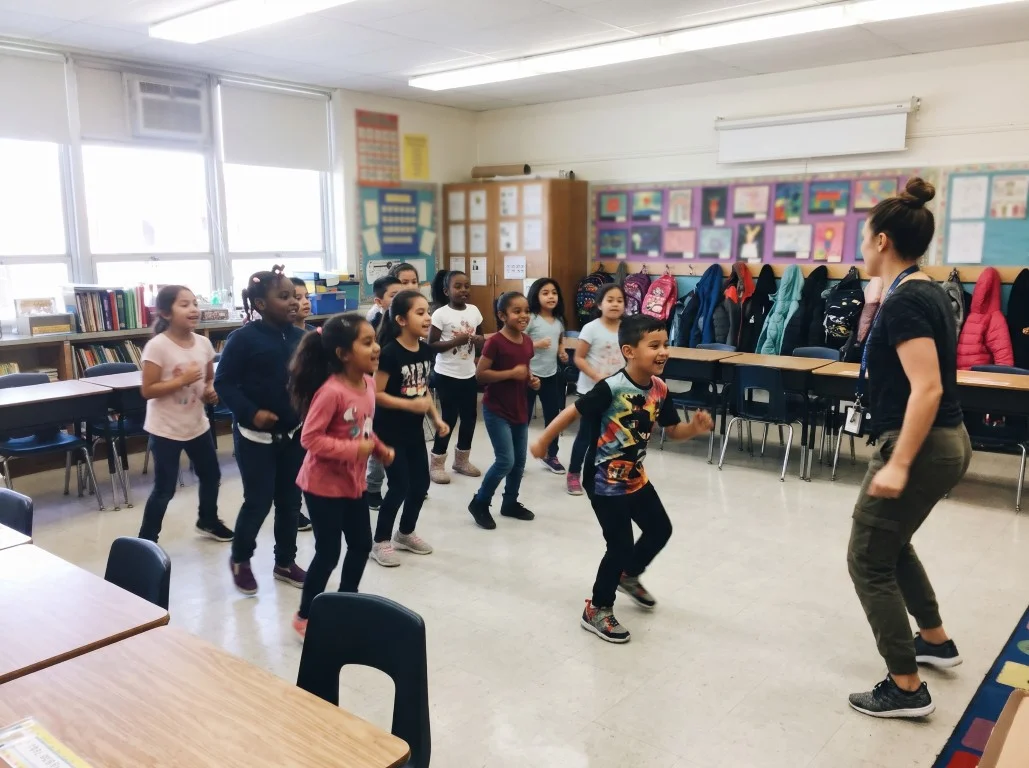
Class size 20:1 (10:1 for TK/K) after school · Full classes in school
Class length 45–60 min (30–60 for TK/K)
Dance programs
Many ways to dance around the world.
One multi-style program and four single-style programs to start. If you have something else in mind just let us know and we can make it happen.
Multi-style
Dance Around the World
A multi-style journey through West African, hip hop, ballet, jazz, folklórico, K-pop, Bollywood, and more, paired with the elements of dance.
Especially special for TK/K!
Single style
Hip Hop
A fun, high-energy class where students learn the building blocks of hip hop dance and the culture it comes from. Along the way, they find their own style and cheer each other on.
Especially special for TK/K!
Single style
Ballet
Leaps, twirls, and story ballets, plus a journey from folk dances and royal courts to the grand stages of Moscow. Ballet for every body. No slippers required.
Great for any age, TK–12
Single style
Folklórico
Zapateado footwork, flowing skirts, and the regional traditions of Mexico, with folklórico’s deep roots in California’s communities.
Great for any age, TK–12
Single style
West African Dance & Drum
Traditional dances and rhythms from Guinea, Mali, Senegal, and Ghana, and how they shaped music and dance across the African diaspora.
Great for any age, TK–12
Don’t see the style you’re looking for?
Our teaching artists have extensive training and experience in many other dance styles. Tell us what your students are excited about, and we’ll build a program around it.
The same joyful, standards-aligned program either way, scheduled around your bell schedule and customized for your students.
After school
ELOP & PTO/PTA
After-school dance programs
Hands-on enrichment for after-school, before-school and intersession programs that meet California’s Quality Standards for Expanded Learning.
20:1 student-to-staff ratio (10:1 for TK/K)
Programs customized for your school so it complements your existing enrichment schedule.
A performance to finish every session
During the school day
Prop 28 · VAPA
In-school dance residencies
Standards-based dance instruction during the school day, planned with your classroom teachers.
Full classes of up to 35 students, with the classroom teacher in the room
Adds to your arts offerings, never replaces them
Research-based curriculum rooted in SEL and STEM concepts designed to improve student learning.
Bigger after-school group? We can discuss adding additional support to keep us compliant.
Standards & funding
Standards aligned
ELOP & Prop 28 ready
Built on the California Arts Standards for Dance
Every class at every grade is aligned to the 2019 California Arts Standards for dance, the state’s current VAPA standards. For ELOP and other after-school programs, our classes support California’s Quality Standards for Expanded Learning. For Prop 28 (Arts and Music in Schools), our in-school residencies are standards-based dance instruction from a community arts partner that adds to a school’s arts offerings instead of replacing them, with the documentation your Prop 28 plan and report need.
Creating
Improvisation, freestyle, and student-made choreography.
Performing
Technique, rehearsal, and a final performance for a real audience.
Responding
Watching dance closely, naming the elements, and giving kind, specific feedback.
Connecting
Linking each style to its culture, its history, and students’ own lives.
Also aligned to
ELOP
Expanded Learning Quality Standards
Prop 28
CA Physical Education Standards
CDE SEL Guiding Principles & CASEL
Classes by grade
Every program, built for every age.
Every program comes in an edition for each age group, with music, pacing, and moves that fit how kids that age learn. Programs are usually about 10 weeks but can be any length. Mixed-age groups are welcome, and our teaching artists adapt the class to fit.
TK–2
Play
Creative play, imaginative movement, and props. Students learn to start and stop on cue, find their “personal bubble,” and move to a steady beat.
Grades 1–4
Groove
Right and left coordination, rhythm, and first short dances. Students discover that dances come from all over the world.
Grades 3–5
Express
Longer 8-count sequences and group choreography. Students learn why each dance began and how communities use it to tell their stories.
Grades 4–6
Practice
Stronger technique, partner work, and first solo freestyle moments. Students help lead warm-ups and perform with confidence for their peers.
Grades 6–8
Build
Complex rhythms, advanced improvisation, student-made choreography, and peer leadership, with body positivity during a big stage of growth.
Grade ranges overlap on purpose, so classes fit however a school groups its students.
Culture in every class
Culture gives every step its meaning.
Every dance style comes from real people and real places. When students know where a dance came from, why it mattered to the community that made it, and how it lives on today, the steps stop being something to copy and become something they understand. That’s where artistry and confidence grow.
Context
Each class starts with a stop on the map: a place, a people, and a story, with the music to match.
Artistry
Knowing the “why” helps students move with purpose, add their own ideas, and dance with real feeling instead of just counting steps.
Confidence
Many students see their own families’ traditions honored. Others discover something brand new. Both walk taller.
Taught with respect
We teach each style in the context of the community that created it, never as a costume, and bring in culture bearers and guest artists whenever we can.
Social-emotional learning
SEL in every step.
Dance is one of the most natural ways for kids to practice social-emotional skills. Each class opens with community agreements and closes with breathwork and reflection, so students leave with tools they can use long after the music stops. Our programs map to all five CASEL competencies and the California Department of Education’s SEL Guiding Principles.
Self-awareness
Naming feelings through movement and finding a personal style in freestyle.
Self-management
Freeze games, breathwork, and matching energy to the tempo of the music.
Social awareness
Learning the cultural stories behind each dance and appreciating classmates’ choices.
Relationship skills
Partner mirroring, group choreography, cypher circles, and cheering each other on.
Responsible decision-making
Using space and props safely, making creative choices, and giving kind feedback.
Every body is a dancing body. No experience needed. We adapt movement for students with IEPs and 504 plans, support English learners with gesture and visuals, and keep every role open to every student.
Our teaching artists
Professional dancers who love to teach.
Every class is led by a trained Culture Club Education teaching artist who knows the style, the culture behind it, and how to run a joyful, well-managed room.
Mentors, not just teachers
Our teaching artists are invested in every student’s growth. They show students how to keep learning on their own, set goals, and build life skills that last long after the last class.
Live Scan (DOJ and FBI) background clearance and TB clearance
Annual mandated reporter training
Trained in SEL, inclusive teaching, and culturally responsive practice
Culture bearers and guest artists join us whenever possible
Everything included
We bring everything. Really.
No equipment to buy, no music to find, no lesson plans to write. We show up ready to dance.
A teaching artist
Trained, cleared, and ready on day one.
Sound & music
A portable speaker and clean, age-appropriate playlists from around the world.
All the props
Scarves, ribbons, story books, and placemats.
Lesson plans
Standards-aligned plans for every grade band.
A final showcase
A class share, assembly, or evening performance. You choose.
Reports & family take-homes
An end-of-session summary for your records and “try this at home” moves for families.
Nothing for you to provide
No props to buy and no setup for your staff. We coordinate the schedule and a space with your site lead and take it from there.
Every program follows the same four-phase arc, scaled to fit your calendar. Most run about 10 weeks, and we also offer short sessions, intersession and summer camps, and semester or year-long partnerships.
Phase 1
Explore
Community agreements, warm-up rituals, and the culture and history behind the dance.
Phase 2
Build
Technique and vocabulary through games, props, partner work, and improvisation.
Phase 3
Create
Choreography, with solo moments and sections students make themselves.
Phase 4
Share
Rehearsal, reflection, and a performance for the school community.
Yes. Our programs plug into ELOP and ASES sites after school, before school, and during intersession, and they support California’s Quality Standards for Expanded Learning. After-school classes keep a 20:1 student-to-staff ratio (10:1 for TK/K).
Can we use Prop 28 funds for a dance program?
Prop 28 (Arts and Music in Schools) funding can support partnerships with community arts organizations that expand a school’s arts instruction. Our in-school dance residencies are standards-based and built to add to your arts offerings, and we provide the documentation for your plan and annual report. Funding rules vary, so please confirm with your district.
How many students can be in a class?
After school (ELOP), we keep a 20:1 student-to-staff ratio (10:1 for TK/K). For in-school residencies (Prop 28), we teach full classes of up to 35 students, with the classroom teacher in the room. For bigger after-school groups we can discuss adding additional support to keep us compliant.
Do students need dance experience or special clothes?
No. Every program is built for beginners, with ways to challenge experienced dancers. Comfortable clothes they can move in are perfect.
What do we need to provide?
Nothing to buy or prepare. We bring the teaching artist, sound system, music, props, and lesson plans, and work with your site lead on the schedule and a space that fits.
Can you serve several grades at once?
Yes. We can run grade-band classes back to back or adapt one mixed-age class.
Tell us about your students and their needs. We’ll set up a quick call and find the right fit for your students whether it is after school or during the school day.
Prefer to talk? Reach out to us and we’ll find a time that works.